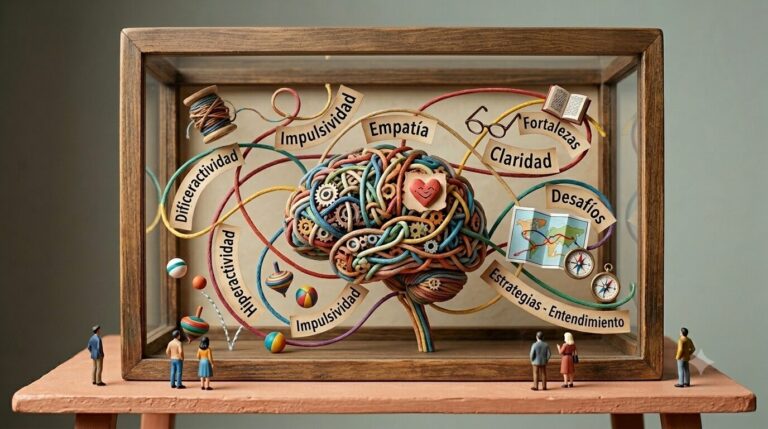

Attention deficit… or difficulty deciding where to put it?
There’s something about the name ADHD—attention deficit hyperactivity disorder—that never quite fits me: the “attention deficit” part.
Because, at least in my experience, many times I don't feel like I'm lacking attention.
Sometimes I feel like I have too much of it.
I can spend three, four, or more hours completely focused on something that interests me. I research, write, create, and search for something that leads me to another thing, and when I look up, I think:
“But what time is it?”
I haven't eaten.
I didn't look at the phone.
I didn't even hear that they were calling me.
And then the inevitable question arises:
Where was my attention deficit during all those hours?
When focusing isn't the problem
This ability to become completely absorbed by an activity is often described as Hyperfocus on ADHD.
And from the outside it can seem contradictory.
How can a person have attention difficulties and at the same time spend hours focused on just one thing?
Precisely because the problem is not always in having or not having attention.
Many times it is in regular use.
In my case, the difference becomes evident when I have to direct that same attention to something that my brain does not consider sufficiently interesting, urgent, novel, or stimulating.
Then everything changes.
A task that could objectively take me ten minutes can turn into a mountain.
I know I have to do it.
I know how to make it.
I even know that I will probably be very slow to start.
And even so, starting can cost me a lot more than spending four hours researching something I’m passionate about.
The hyperfocus has another side too
Sometimes we talk about hyperfocus almost as if it were a superpower.
And yes, it can have a wonderful part.
When something excites me, I can create, research, learn, and deepen my knowledge for hours.
But there is also the other side.
Because delving deeply into something does not necessarily mean being able to decide when to leave.
You can lose track of time, delay other tasks, forget to eat, or discover that what was supposed to take you half an hour has taken up a good chunk of the afternoon.
Therefore, for me, understanding ADHD solely as a lack of attention is insufficient.
“For what you’re interested in, you better focus”
I think many people with ADHD have heard some version of this phrase at some point:
“For what you’re interested in, you better focus.”
Well, yes.
Exactly.
And for a long time that phrase can make you think that the problem is simply a lack of willpower.
“If I can concentrate here, I should be able to do it there.”
But my experience doesn't work that way.
I can't always choose with the same ease where to focus my attention, when to activate it, and when to remove it from what has taken hold of me.
And understanding that difference changes things a lot.
Because you start to wonder:
“Why don’t I try harder?”
I asked you:
“What does my brain need to be able to start this?”
And that second question is much more useful.
I don't need more blame, I need to understand how it works
It helps me a lot more to think of ADHD as a difficulty in regulating attention than as a simple inability to concentrate.
No significa que pueda controlarlo todo una vez que lo entiendo.
Ojalá. Nos ahorraríamos unas cuantas agendas abandonadas por el camino.
Pero sí me permite observarme de otra manera.
- ¿Por qué esta tarea me resulta tan difícil de empezar?
- ¿Puedo dividirla?
- ¿Necesito hacerla más visible?
- ¿Puedo introducir movimiento, novedad o una pequeña recompensa?
- ¿Estoy esperando a sentir ganas para comenzar?
De repente, en lugar de luchar constantemente contra mi cerebro, puedo empezar a diseñar algunas cosas teniendo en cuenta cómo funciona.
Quizá la pregunta no sea “¿puedes concentrarte?”
Quizá sea:
- ¿Puedes decidir fácilmente en qué concentrarte?
- ¿Puedes empezar cuando necesitas empezar?
- ¿Puedes cambiar de tarea cuando toca?
- ¿Puedes parar cuando algo te ha atrapado?
Para mí, ahí está una parte importantísima de la conversación sobre el TDAH.
Porque muchas veces no es:
“No puedo concentrarme.”
Es:
“No siempre puedo elegir fácilmente en qué me concentro, cuándo empiezo… y cuándo consigo parar.”
Y cuando entendí esa diferencia, muchas cosas de mi propia historia (que puedes seguir explorando en mis reflexiones) empezaron a tener bastante más sentido.
Si te reconoces en esta forma de vivir con la cabeza a mil, en Going a mile a minute all day long comparto más experiencias y herramientas…
Did you relate to this?
📖 In my book Going a mile a minute all day long you will find practical tools to manage impulsiveness, mental overload and intense emotions.
👉 You can also subscribe to receive new articles and free resources.
Do you want me to write about a specific topic? Write to meI also collaborate with media outlets and companies creating content about ADHD, well-being, and mental health.